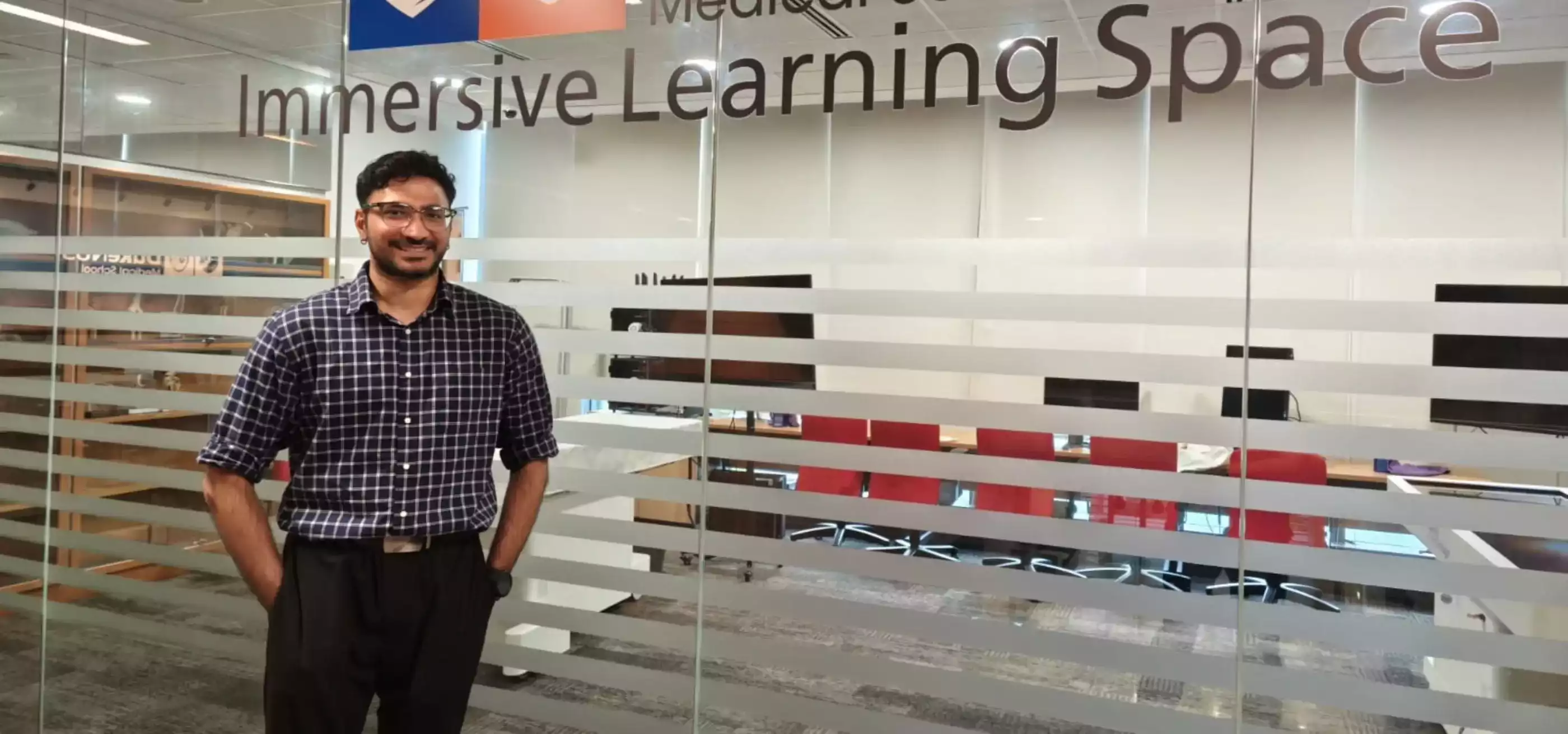
As industries increasingly rely on evolving technologies to solve complex business needs and challenges, the demand for skill professionals who can fill this gap continues to grow. BS in Computer Science in Real-Time Interactive Simulation graduate Sri Sham Haran is part of the solution at Duke-NUS Medical School, where he develops immersive learning systems and experiences to reshape medical training and transform how future doctors learn and practice.
As an educational technologist at Duke-NUS, Sri combines his technical skills with his passion for innovation. His main focus is developing immersive educational solutions that transform how medical students learn. These can be through traditional applications used as learning or revision resources, or as extended reality (XR) applications that enable medical students to practice clinical procedures in virtual environments.
What draws Sri most to his work is the pioneering nature of XR development, which Sri has grown a deep interest in. “It’s a different medium of interaction that is still relatively new,” he says. “This means there’s plenty to learn and discover.” Sri views these immersive solutions as a critical part of technology’s future, particularly as we integrate more spatial data into our digital interactions.
Creating immersive learning experiences requires a nuanced approach that often surprises people unfamiliar with XR development. Unlike other traditional software applications, immersive projects demand careful attention to user comfort and immersion. Sri adds that ease of use is particularly crucial. “While XR allows us to get creative with how we interact, we’re also mindful of staying grounded in what the user already knows,” he explains. “Familiar interactions mean the user will have an easier time using these applications.” This balance between innovation and usability is especially critical for educational applications, ensuring users can focus on learning rather than struggling with technology.
Sri’s DigiPen (Singapore) education has also proven instrumental in preparing him for the technical demands of his role. “I work with a lot of 3D models and systems and am required to do lots of calculations that involve physics, collision, and math — all topics that we learn to great extents as computer science students at DigiPen,” he explains. “I also discuss concepts like colliders, mesh processing, and optimization at length with my colleagues, and I feel I wouldn’t have a clue about these things if it weren’t for my time at DigiPen,” Sri adds candidly.
The curriculum’s introductory VR module also laid essential groundwork, teaching Sri about the fundamentals of XR systems and key development considerations. But beyond just technical knowledge, DigiPen (Singapore) has also honed Sri’s critical thinking abilities — a skill his colleagues have noticed. “I’m often told that I can come up with solutions to issues in our applications quickly,” he says. “Plenty of our project work in school has trained our problem-solving skills.”
Though Sri greatly enjoys his work and the impact it brings, the role also has its challenges. User experience (UX) design, a crucial aspect of creating effective and immersive learning applications, was initially unfamiliar territory. “It’s not something I’m used to at all,” Sri admits, adding that it was a struggle in the beginning. Thankfully, his supervisor’s expertise in the area provided valuable guidance. “I understand a lot more about the considerations and methods that go into effective UX design now,” he says.
Reflecting on his career so far, Sri is thankful to be engaged in meaningful work. “It has been really cool to see how technology is being used to enhance learning here,” Sri says. Being part of this intersection of cutting-edge technology and medical education means contributing to how future healthcare professionals are trained — a mission that keeps him excited about the work ahead.