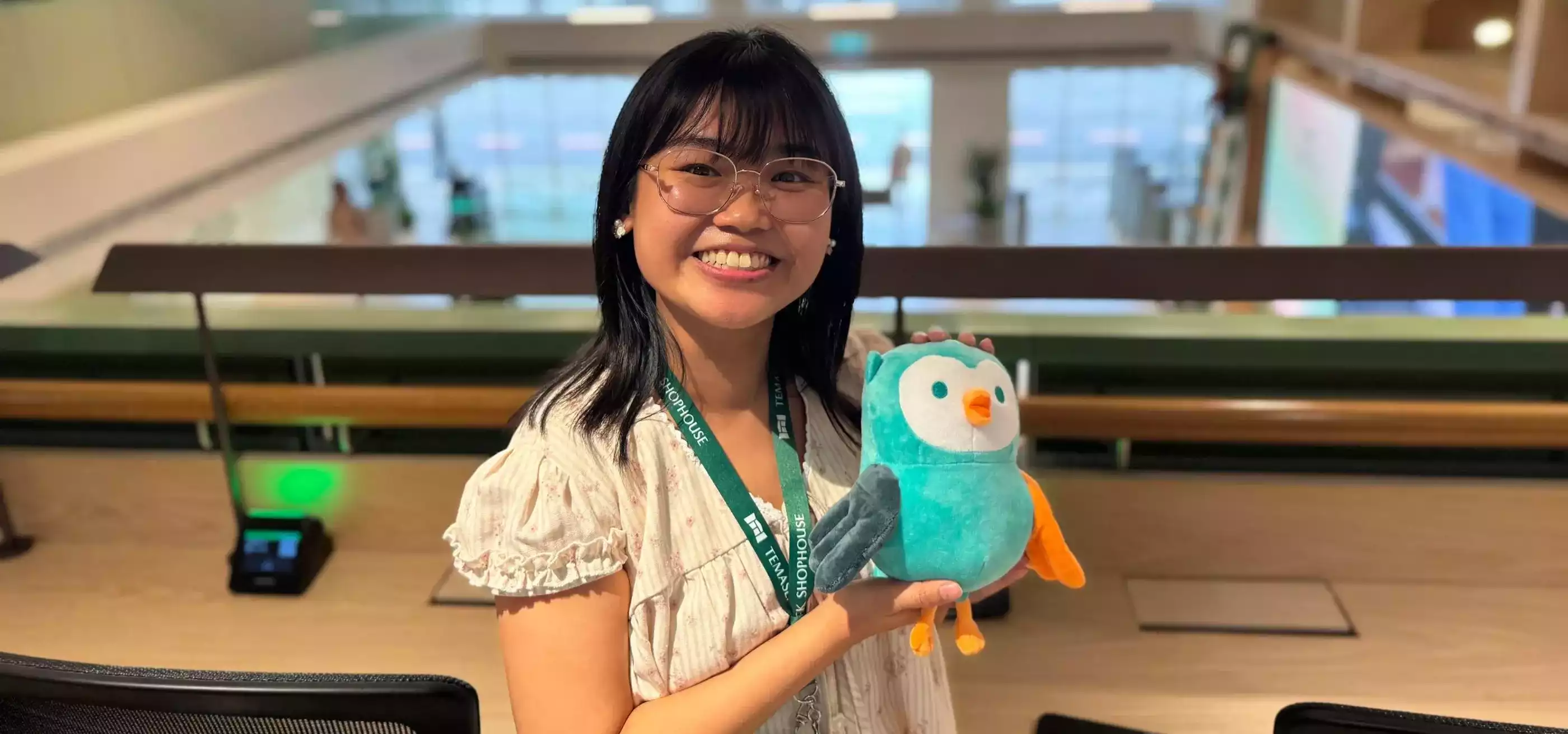
How do you make financial planning feel less daunting? For BA in User Experience and Game Design graduate Sandy Kee, the answer lies in good design. As a UI/UX product designer at MoneyOwl, Sandy creates digital experiences that help users navigate complex financial information with clarity.
Sandy’s foray into design first began while pursuing her Diploma in Information Technology at Ngee Ann Polytechnic. There, she took up an internship at GovTech that introduced her to the realities of UI/UX work for the first time. “It was a steep learning curve,” Sandy recalls. “I went from conducting UX interviews and translating problem statements into actual features and user interfaces, to developing with HTML5, CSS, and JavaScript.” Though initially overwhelming, the experience proved transformative. With the guidance of her mentors, Sandy gained a firsthand glimpse into how digital products are built, and realized that UI/UX design was the path she wanted to pursue.
With this goal in mind, Sandy looked for relevant programs to further her education after polytechnic. DigiPen (Singapore)’s BA in User Experience and Game Design stood out immediately for the depth of its curriculum. “What drew me to DigiPen was its focus on design that goes beyond the surface — exploring the behavior and psychology behind how people interact with technology,” Sandy says. The program’s emphasis on designing interactive systems across software, user experience, games, and emerging platforms like virtual and augmented reality further aligned with her interests and ambitions.
At DigiPen (Singapore), Sandy honed both her creative and technical skills through an interdisciplinary, project-focused curriculum. She had the chance to collaborate on large-scale projects with students from not just design, but art and computer science backgrounds as well. Sandy recalls an instance where her team’s custom engine was loading slowly due to the volume of art assets. “By listening and understanding the technical constraints that the computer science students explained, I proposed merging multiple elements into a single grouped asset, which significantly improved performance,” Sandy says. This experience taught her the importance of bridging the gap between design intent and technical feasibility — a skill she continues to rely on in her current role.
Today, Sandy is part of the product design team at MoneyOwl, a social enterprise dedicated to enabling better financial security for all throughout life’s journey, by providing holistic financial advice and solutions. Sandy was inspired by this and saw it as an opportunity to make a meaningful impact. “I believe in inclusive technology that helps people navigate important decisions,” she says. “MoneyOwl’s focus on empowering users across different life stages really resonated with me.”
As a UI/UX product designer, Sandy’s scope of work spans the entire product lifecycle. She designs responsive web interfaces in Figma, optimizes layouts for platforms like WordPress Elementor, and collaborates closely with developers to implement features. She also conducts usability tests, identifying bugs and issues to improve overall user experience. Beyond design, Sandy contributes to front-end development, using HTML, CSS, and JavaScript to build interactive tools like financial calculators.
User research also forms a large part of Sandy’s work. She uses tools like Hotjar — which provides heatmaps and session recordings that track how users interact with MoneyOwl’s pages — to analyze user behavior and make design improvements. For example, Sandy pitched a redesign of the OwlChecklist webpage after observing that users were skipping large portions of the content. She helped restructure the page into cleaner, more digestible sections, and replaced less relevant content with practical tools like financial calculators. The result was a more focused and purposeful user journey, with every element on the page serving a clear and consistent purpose.
The transition from designing school projects to working in the financial planning space was not without its challenges, especially since Sandy had no prior financial planning background. She built up her financial literacy by completing a financial planning course by MoneyOwl, and absorbing knowledge on everything from CPF policies to HDB regulations. Her colleagues’ generosity in sharing their expertise also made the learning curve more manageable.
Reflecting on her experiences so far, Sandy is quick to dispel the common misconception that UI/UX design is simply about making things look nice. Instead, she explains that the heart of it all is designing interactions that guide users to take the right actions. For those keen on pursuing a similar path, Sandy’s advice is this: “Keep an open mind and embrace curiosity. Focus on empathy — both towards users and the technical teams you partner with. Understanding what users truly need and appreciating the constraints developers face, is what makes a good designer.”