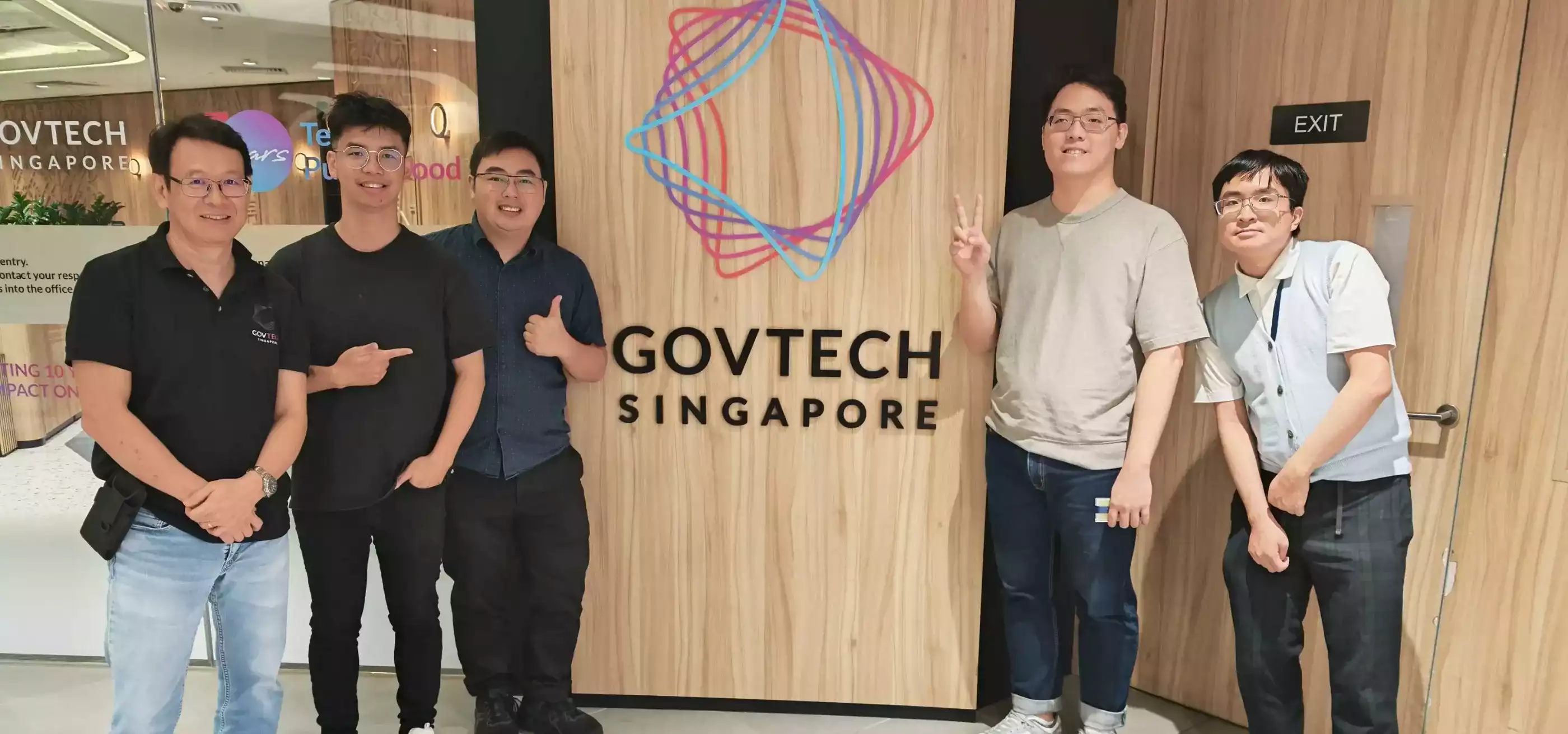
The Punggol Digital District (PDD) is Singapore’s first smart and sustainable district, designed as a place where the community, businesses, and education institutions can come together to innovate. And at the heart of the PDD lies the Open Digital Platform (ODP), a shared digital layer that enables stakeholders to design, test, and deploy module software systems across the district. Co-developed by the Government Technology Agency of Singapore (GovTech Singapore) and JTC Corporation, the ODP transforms PDD into a “living laboratory” where emerging technologies can be validated in real-world conditions.
PDD is also the launchpad for two exciting digital twin projects that DigiPen (Singapore) is involved in. But first, what are digital twins? Simply put, a digital twin is a virtual replica of a physical object, system, or environment that mirrors its real-world counterpart. By using sensors to collect data, it can reflect actual conditions in real-time, allowing users to test changes, simulate scenarios, or make predictions without experimenting directly on the physical asset. Digital twins can thus be applied in multiple scenarios, from modelling traffic flow to automating and stress-testing systems before they go live.
DigiPen (Singapore)’s work in digital twin technology has been steadily growing through our research and development (R&D) arm. It began in 2024, when we partnered with the Singapore Institute of Technology (SIT) to co-develop a virtual campus — a digital twin of SIT’s Punggol Campus. The project plays directly to one of our core strengths: drawing on our heritage in game development, simulation, and interactive systems, the Institute is leading development of the underlying engine powering the virtual campus.
Building on this momentum, DigiPen (Singapore) recently entered into a collaboration with GovTech Singapore to launch a dedicated R&D lab within PDD focused on building digital twins for government applications. This work is carried out through the ODP, where GovTech Singapore and SIT-DigiPen (Singapore) can develop modular, reusable software components. This government-academia partnership was established partly due to proximity, and partly through a natural meeting of technical minds.
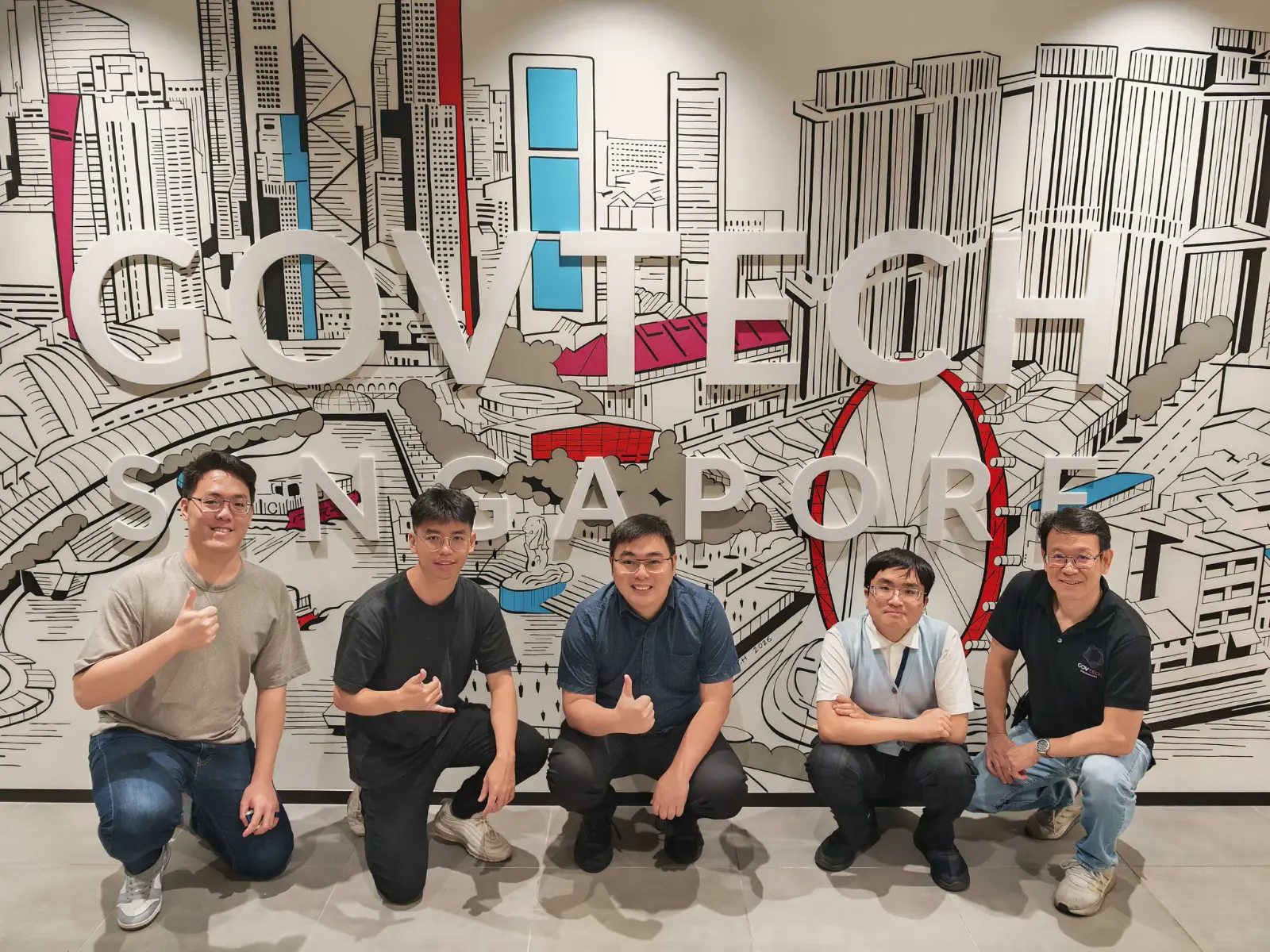
“SIT-DigiPen (Singapore) has deep expertise in real-time engines because of its game development background, and the underlying technology for GovTech Singapore’s digital twins is also based on real-time engines,” says Teo Lip Seng, Senior Systems Engineer, GovTech Singapore. This alignment is where DigiPen (Singapore)’s interns come in. Working alongside the GovTech team are four SIT-DigiPen (Singapore) interns — Benjamin Chaing, Mog Shi Feng, Nam Kai Zhe, and Wesley Tan — who are helping develop reusable software modules for various digital twins. All of them are from the BS in Computer Science in Real-Time Interactive Simulation program, and bring their skills in C/C++, real-time engines, geometry, and asset management in their day-to-day work, where they experiment with surrogate models for modeling and simulation.
Though the interns only started recently, their contributions have not gone unnoticed. “SIT-DigiPen (Singapore) interns are able to contribute meaningfully from day one,” Lip Seng says. “Their eagerness to learn and strong foundation have made it easy for them to quickly add value while working alongside our team.”
This internship program is only the beginning. According to Lip Seng, the work serves as a foundation for far broader collaboration across the PDD, including with the district’s developer and other tenants in the area. Because the software being developed is modular and reusable, it can be shared and adapted across different projects, accelerating the testing and deployment of new ideas in the district.
DigiPen (Singapore) is grateful to bring our expertise in real-time simulation to one of Singapore’s most ambitious smart district projects. With the SIT virtual campus underway and the new GovTech R&D lab partnership, we look forward to not only advancing digital twin technologies, but also nurturing the future talent pool that will sustain them.